
Welcome to Peterson
Community Hub
Built in the 1950s, the Peterson School served generations of families as both an educational institution and a civic anchor. It closed in 2017, as many rural schools have across the Midwest. In 2022, Scott Smith and Deanna Arce purchased the building and launched the Peterson School Project — a long-term commitment to transforming this mid-century modern landmark into a living, breathing community resource.
The East Wing (currently being renovated), operated by Peterson Community Hub, a 501(c)(3) nonprofit, is the public heart of that vision, with a variety of spaces available to rent. The Oneota Room (aka "the gym") is a large multi-purpose gathering space ideal for performances, receptions, classes, and community events — and it's home to the newly restored Peterson Stage. Long sealed behind concrete blocks, the stage has been opened up and given new life, ready once again to host performances, speakers, and celebrations. Two sweeping new doorways now connect the Oneota Room and the Jordan Café, and when combined with the Spillville Kitchen, the spaces flow together into something truly unique — a flexible, open venue unlike anything else in the region. Two large garage doors open directly onto the Root River Terrace, where guests are greeted by sweeping views of the limestone bluffs and the Root River winding through the Driftless valley below. Private offices — the Prosser and the Decorah — are available free of charge for telehealth appointments and remote work.
The renovation of the East Wing has been made possible in significant part by a generous public grant. We are deeply grateful for this investment in our community and look forward to acknowledging our funders publicly when permitted.


ROOTED IN PLACE
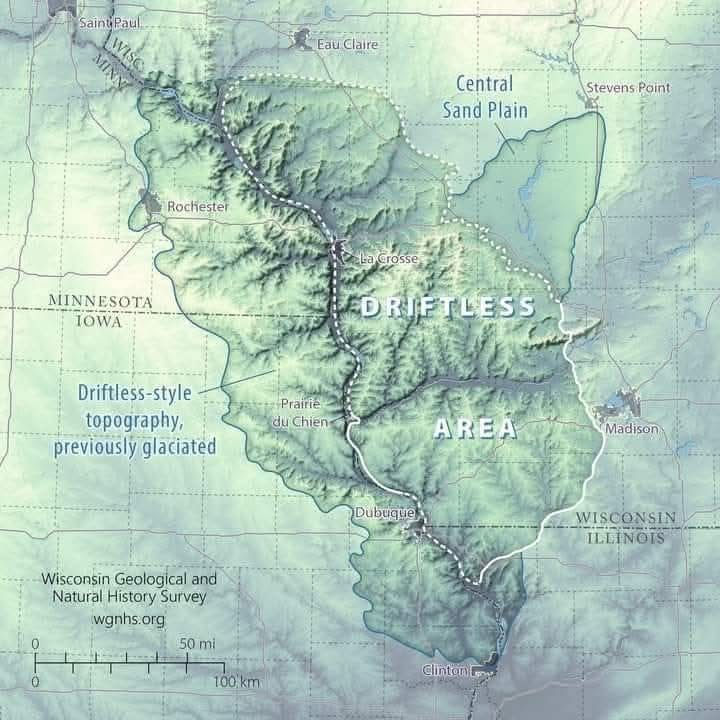
Ice, Water, and the Driftless
The ground beneath the Peterson School tells a story that begins long before the building, before the town, before even the river. During the Cambrian and Ordovician periods — roughly 500 to 450 million years ago — this part of Minnesota lay beneath warm, shallow seas. Sand, silt, and carbonate sediments settled on the seafloor in layers, one era on top of another, and slowly hardened into the rock that now forms the bluffs, valleys, and springs of southeastern Minnesota.
Those layers have names — and you'll find them on some of the rooms in the East Wing. The Jordan Sandstone, deposited on ancient shorefaces as seas retreated. The Oneota Dolomite, formed in tidal flats when the water returned and carbonate sediments blanketed the region. The Decorah Shale, rich with the fossils of crinoids, bryozoans, and brachiopods from a sea that covered most of the continent. The Prosser Limestone, part of the Galena Group that caps the high plateaus of Fillmore County. And the Spillville Formation, a Devonian limestone laid down in yet another shallow sea millions of years later. Each room at Peterson Community Hub is named for a layer of rock in the stratigraphic column beneath our feet — a reminder that this place sits on a history measured not in decades, but in hundreds of millions of years.
During the last Ice Age, massive glaciers reshaped most of Minnesota. But this region — known as the Driftless — was largely bypassed. Because it escaped glacial smoothing, the landscape here retained its steep bluffs, narrow valleys, exposed bedrock, and spring-fed streams. The Root River carved its winding path through that ancient rock, and the result is the view from the Root River Terrace: limestone bluffs that have been taking shape for longer than most landscapes on earth have existed.
The region's karst geology — fractured limestone and sinkhole-prone bedrock — creates direct connections between surface water and groundwater. That produces extraordinary ecological richness, including trout streams and rare bluffland habitats. It also means the land is especially sensitive to what happens on its surface. The same geology that makes this place beautiful makes it vulnerable — and deeply interconnected.
The Oneota Room
The Oneota Room is the heart of Peterson Community Hub. This expansive 6,000-square-foot gathering space has been beautifully renovated, finished with warm Douglas fir paneling and a gleaming terrazzo floor that honors the building's mid-century roots while feeling entirely fresh. Home to the newly restored Peterson Stage — sealed behind concrete blocks for decades and now opened again — the Oneota Room is ready for performances, speakers, receptions, fitness classes, community celebrations, career fairs, and more. Two sweeping new doorways connect seamlessly to the Jordan Café and Spillville Kitchen, making it possible to combine all three spaces into one remarkable, flowing venue.
The Jordan Cafe & Root River Terrace
The Jordan Café is intimate, warm, and unlike anything else in the Driftless. The Jordan Café is a beautifully finished gathering space with a personality all its own — and a view that stops people in their tracks. Two large garage doors open wide onto the Root River Terrace, dissolving the line between inside and out and framing a sweeping panorama of the Root River and the ancient limestone bluffs that have shaped this valley for hundreds of millions of years. It is one of the most striking views in southeastern Minnesota, and it is right outside your door.
Perfect for social gatherings, small receptions, workshops, birthday parties, and rehearsal dinners. Connect it through the new doorways to the Oneota Room and the Spillville Kitchen for a flowing, one-of-a-kind combined venue that can accommodate nearly any occasion.
The Spillville Kitchen
Newly renovated and ready to work. The Spillville Kitchen is a fully equipped kitchen with a beautiful bright floor, designed for caterers, cooking classes, community meals, and food-service preparation. Whether you're supporting a large event in the Oneota Room or hosting a hands-on cooking demonstration of your own, this kitchen has the space and equipment to make it happen. No more than 10 people at a time.

Stewardship and Renewal
Anchored to the Past
Anchored to the Past
Long before European settlement, this land was home to Indigenous peoples who lived in relationship with its rivers, prairies, and wildlife. Peterson sits within the traditional homelands of the Dakota people, and the broader region has long been connected to Ho-Chunk (Winnebago) and Ojibwe Nations through seasonal movement, trade, and cultural exchange. We acknowledge that Peterson Community Hub exists on Indigenous land, and we commit to continued learning, humility, and relationship as this project evolves.
In the mid-1800s, Norwegian immigrants settled along the Root River, drawn by fertile soils and a landscape reminiscent of home. Peterson was platted in 1853 and grew around agriculture and the railroad. Like many rural communities, its economy shifted as rail declined and highways reoriented travel. Some residents left; others stayed. The former rail corridor is now the Root River State Trail. The Peterson School, built in the mid-20th century, served generations as both a school and a civic anchor — until consolidation closed it. Its halls went quiet, but the building remained.


Caring for Place
In 2022, Scott Smith and Deanna Arce purchased the former Peterson School with a vision rooted in stewardship. Rather than a short-term redevelopment, they recognized the building as a civic asset worth investing in for the long term. The Peterson School Project divided the structure into two wings: the West Wing for residences and artisan studios, and the East Wing — now operated by Peterson Community Hub, a 501(c)(3) nonprofit — dedicated to public, community-centered use.
Renovation is underway, supported by a major public grant. PCH carries forward the spirit of education — not as a return to classrooms alone, but as lifelong, community-based learning. On land shaped by ancient seas and living rivers, this project holds a simple idea: caring for place requires caring for one another, and building community is inseparable from stewarding the land beneath our feet.

Support the Hub
Make a Donation
Peterson Community Hub brings education, health, creativity, and connection together in a welcoming rural gathering place. Every dollar is tax deductible, and every dollar stays right here in Peterson.
Mailing a check saves us processing fees, so more of your gift goes straight to the Hub. Make checks payable to Peterson Community Hub and mail to 193 Park Street, Peterson, MN 55962.
Match Your Gift. Double the Hub.
Thousands of companies match the charitable gifts their employees make — often dollar for dollar. A $100 gift becomes $200. Most of it goes unclaimed because nobody asks.
-
Ask HR if your company matches — retirees and spouses often qualify too.
-
Name Peterson Community Hub as your charity. Not on their list? Ask them to add us.
-
Send us the form and we'll handle the rest.
Peterson Community Hub · Minnesota 501(c)(3) · EIN 39-3984252 · 193 Park Street, Peterson, MN 55962 · info@petersoncommunityhub.org